
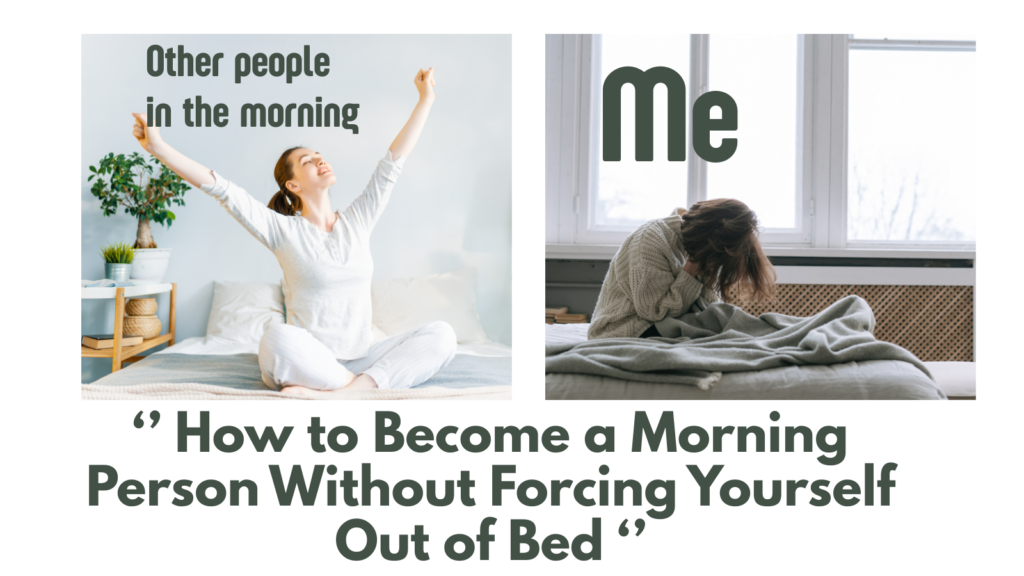
You don’t hate mornings. You hate how they feel.
The alarm goes off. You’re already tired. You hit snooze. Maybe twice. Maybe five times. Then you rush. No calm start. No “winning the day”. Just stress before 9am.
And every time you see someone talk about their two-hour morning routine — journalling, ice baths, meditation, green smoothies — you think, that’s great, but I don’t have time for that.
So you tell yourself you’re “just not a morning person”.
Here’s the truth: you’re not broken. And you don’t need a long routine.
Most people fail at becoming a morning person because they try to force it. They rely on discipline instead of design. They attack the alarm instead of fixing what makes waking up hard in the first place.
If you don’t have time for a complicated routine, good. You don’t need one.
In this article, you’ll learn how to make mornings easier — not extreme, not miserable — just simple shifts that work with your biology and your schedule.
The Real Reason You’re Not a Morning Person
Let’s clear something up.
You’re not bad at mornings because you’re lazy. You struggle because of friction.
Two things control how you feel when you wake up:
- Sleep timing
- Light exposure
If you go to bed late, scroll until midnight, and wake up in a dark room to a harsh alarm, of course you’ll feel awful. Anyone would.
Becoming a morning person isn’t about becoming tougher. It’s about reducing friction so waking up feels neutral — not painful.
When waking up stops feeling like a fight, you stop needing willpower.
Step 1: Fix the 30 Minutes Before Bed
If you want easier mornings, stop trying to “fix” the morning first. Fix the end of your evening.
You don’t need a long wind-down routine. Just this:
Create a 30-minute buffer before sleep.
During that half hour:
- Dim the lights.
- Get off your phone (or at least reduce brightness).
- Do something boring and calm — shower, light stretching, reading.
Why? Because light and stimulation tell your brain to stay alert. Reduce both, and your body starts producing melatonin earlier. That means falling asleep faster and sleeping deeper.
You don’t need candles and herbal tea. You just need less stimulation.
If you only change one thing from this article, change this.
Step 2: Shift Your Wake Time in 15-Minute Blocks
If you currently wake at 7:30 and want to wake at 6:30, don’t jump straight there.
That’s why people fail.
Instead:
- Move your alarm 15 minutes earlier.
- Stay there for 4–5 days.
- Then shift another 15 minutes.
It sounds small. It is small. That’s the point.
Your body clock adjusts gradually. Big jumps feel like jet lag. Small shifts feel manageable.
And here’s the rule most people ignore:
Do not cut your sleep short.
If you move your wake time earlier, your bedtime must move earlier too. Otherwise you’re just creating sleep debt — and no one becomes a morning person while exhausted.
Step 3: Create a 5-Minute Anchor (Not a 90-Minute Routine)
You don’t need a long routine. You need a reason to get up.
Instead of building a complex ritual, pick one small, repeatable action that takes five minutes.
Examples:
- Make coffee and sit somewhere quiet.
- Step outside for fresh air.
- Read two pages of a book.
- Do five minutes of light movement.
That’s it.
This becomes your anchor. It signals: “My day has started.”
Most people overcomplicate mornings. But consistency beats intensity. A five-minute habit you repeat daily is more powerful than a two-hour routine you abandon after a week.
Step 4: Make It Easier Than Staying in Bed
Right now, your bed is winning.
You need to tip the balance.
Here’s how:
- Put your alarm across the room.
- Open your curtains immediately.
- Turn on lights straight away.
- Wash your face with cool water.
Light is powerful. It tells your brain to stop producing melatonin and increase alertness. The faster you get light exposure, the faster you feel awake.
You’re not trying to “motivate” yourself out of bed. You’re changing the environment so staying in bed feels less appealing.
Design beats discipline.
Step 5: Stop Romanticising 5am
You don’t have to wake up at 5am to be productive.
For some people, that works. For others, it’s unnecessary.
If waking up 45 minutes earlier gives you space and calm, that’s enough.
The goal isn’t to join a club. The goal is to stop feeling rushed.
Becoming a morning person simply means this:
You wake up at a consistent time and don’t hate it.
That’s it.
What If You Still Struggle?
Some people are naturally more alert later in the day. That’s normal.
But even night-leaning people can improve mornings by:
- Keeping a consistent sleep schedule.
- Reducing late-night light exposure.
- Avoiding large wake-time swings at weekends.
If you’re sleeping five or six hours a night, no strategy will fix that. Sleep duration matters.
You can’t optimise your way out of exhaustion.
The Simple Formula
If you want this to stick, focus on four things:
- Protect your sleep.
- Dim lights 30 minutes before bed.
- Shift wake time gradually.
- Keep your morning anchor small.
No heroic routines.
No forcing yourself up.
No pretending you love sunrise if you don’t.
Just less friction.
You don’t become a morning person by overpowering your alarm.
You become one by making sleep better and mornings easier.
Small shifts feel insignificant in the moment. But after a few weeks, you’ll notice something surprising:
You wake up… and it’s fine.
Not dramatic. Not euphoric. Just easier.
And when mornings stop feeling like a battle, everything else in your day starts from a better place.
You don’t need a brutal alarm.
You don’t need a two-hour routine.
And you definitely don’t need more willpower.
You need less friction.
If you dim the lights before bed, protect your sleep, shift your wake time gradually, and keep your morning simple, something changes. Waking up stops feeling like punishment. It starts feeling neutral. Manageable.
And for someone with a busy schedule, that’s the win.
Forget the 5am fantasy. Focus on consistency. Focus on making it easier, not harder.
Because becoming a morning person isn’t about dragging yourself out of bed.
It’s about building a life where getting up feels natural — and you don’t have to force a thing.
Purity Blog